
Tips for better collaboration between Design & Development
But the obstacles can be overcome. The best thing is for designers and developers to pay attention and communicate with each other right from the start.
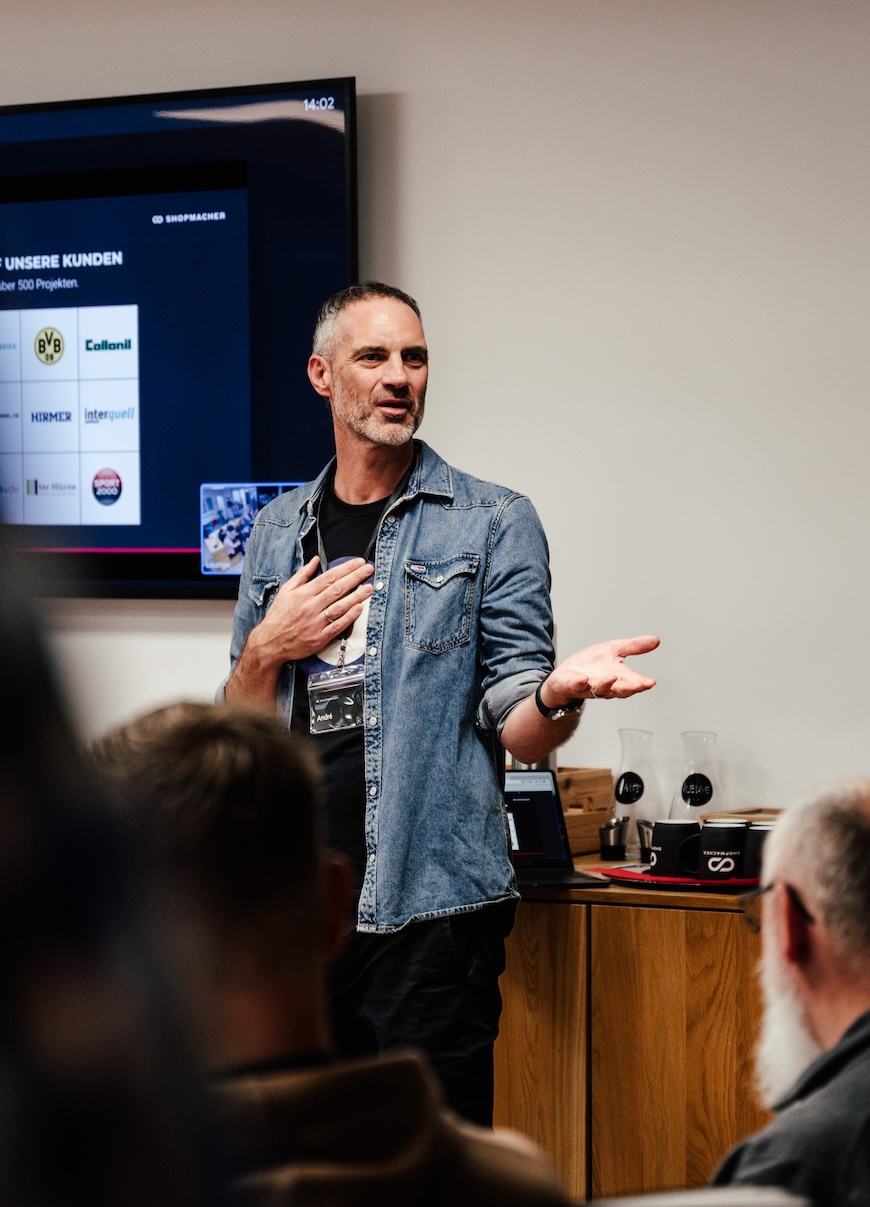
PAGE asked André Roitzsch, CEO at SHOPMACHER, four questions about this.
1. In your opinion, what are the biggest problems in the collaboration between development and design for online shops?
André Roitzsch: One of the main problems in the collaboration between design and development is the sequential approach: If the design is first fully developed, approved and then transferred to the technical implementation, difficulties often arise at this point. This is because designers are not always aware of the technical limitations of the chosen store system. This results in design specifications that are sensible and attractive from a design perspective, but whose implementation is unnecessarily complex or costly from a technical perspective.
On the other hand, developers sometimes lack an understanding of which “minor” deviations from the design would be acceptable without undermining the overall design concept. In such cases, additional coordination is required – up to and including re-approval by the design team, which results in delays and frictional losses.
But it is also often a one-way street from the other end: if technical concepts are developed in advance and then “adapted” to the corporate design, design corrections can cause considerable additional work during development – especially if they are introduced retrospectively and were not originally planned.
2. How can improvements be achieved with regard to the points mentioned?
In addition, a realistic database is essential. In the conception phase, idealized sample data is usually used – which leads to aesthetically pleasing, but not always realistic results. As soon as real product data from third-party systems comes into play, inconsistencies quickly become apparent that affect both the design and the technical structure. A common understanding of data origin, structure and logic helps to counteract this at an early stage.
3. Do you have any everyday tips on UX and UI design for designers in companies that operate online shops?
Another success factor is a clean, comprehensibly documented data model.
In the commerce environment in particular, it is crucial to understand that design work largely consists of visualizing data. If you know the structure, origin and processing of this data, you can design more effectively and efficiently.
In addition, a basic technical understanding is a great advantage for designers – especially knowledge of HTML, CSS and ideally a basic understanding of JavaScript. In our onboarding process, we therefore emphasize that designers work independently with store or editorial systems, create templates and build pages. The practical experience of technical possibilities and limitations not only promotes understanding, but also increases the quality of the subsequent design specifications.
4. Do you have any tips for developers?
A good eye for design – at least the basics – is part of a front-end developer’s expertise. Those who recognize deviations, take visual details seriously and suggest constructive alternatives contribute significantly to a high user experience – without losing sight of technical efficiency.
ALSO INTERESTING

Digitally accessible – or soon to be left out?
The countdown is on: On June 28, 2025, the Accessibility Reinforcement Act (BFSG) will come into force. But reality shows that many online stores are not yet ready. The new Accessibility Study 2025 reveals: The digital shopping world is still full of avoidable hurdles.
The Shopmacher are a member of the MACH Alliance
If you want to become a member of the MACH Alliance, you have to prove that MACH doesn’t just stand on slides, but works in real systems. The certification process is rigorous and the requirements are high. And that is precisely why this admission is special for us. Only a few agencies worldwide have provided this proof. The Shopmacher now have too. And yes, we are damn proud of that.

Heart partner Centric
Shopmacher has been officially working with Centric since 2024 and currently supports two joint customers.
A special award: Shopmacher received the Centric “Newcomer of the Year” award back in 2025.