
How retailers ruin their onlineshop system calculations
But what often seems like a no-brainer at first glance is often the most expensive of all decisions, says Sabine Götz, Lead Consultant at SHOPMACHER, which supports online retailers in optimizing their tech stack. This is because in order to determine the actual costs, retailers must take into account not only one-off license and implementation costs, but also the expenses that become decisive over the life cycle of three to five years.
Cheap to get started, expensive for everyday use
Cloud vs. on-premise: the paradox of the “cheap” license
“The price tag triggers the savings reflex,” says Sabine Götz. “But to really find the most cost-effective solution for each individual, you need to take a holistic view.”
Strategic inflexibility with excessive budgets
A holistic total cost of ownership analysis forces retailers to think about the life cycle. To support online retailers in this sometimes complex process, Shopmacher has developed an internal TCO tool that systematically maps all cost blocks over three to five years. “For us, this is not a sales argument, but a mandatory tool,” emphasizes Götz. “Because only those who honestly calculate their total costs can ultimately make the right platform decision.” Those who fail to do so not only pay more, but also lose time, opportunities and competitiveness.
Checklist: What belongs in a TCO analysis
If you want to reliably calculate the total cost of ownership (TCO) for your e-commerce platform, you should at least take these points into account:
- Business scenarios & KPIs
- Transactions, basket values, growth rates
- Expected scaling (e.g. international expansion, peaks)
- License and subscription costs
- Annual or usage-based fees
- Cost increases with higher transaction volumes
- Initial costs (setup & migration)
- Project management, implementation, customizing
- Data migration, content, design and templates
- Integration into existing systems
- ERP, PIM, CRM, payment, logistics, marketing automation
- Effort for interfaces and adjustments
- Operation & Infrastructure
- Hosting, cloud capacities or data center
- Security, monitoring, backups, energy
- Maintenance & Updates
- Regular software releases
- Effort for adjustments for system updates
- Risk of “technical debt” in the event of late updates
- Support & Service
- Internal and external support
- SLAs, ticket systems, service providers
- Training & productivity
- Training for teams
- Induction of new employees
- Time lost due to complexity or failures
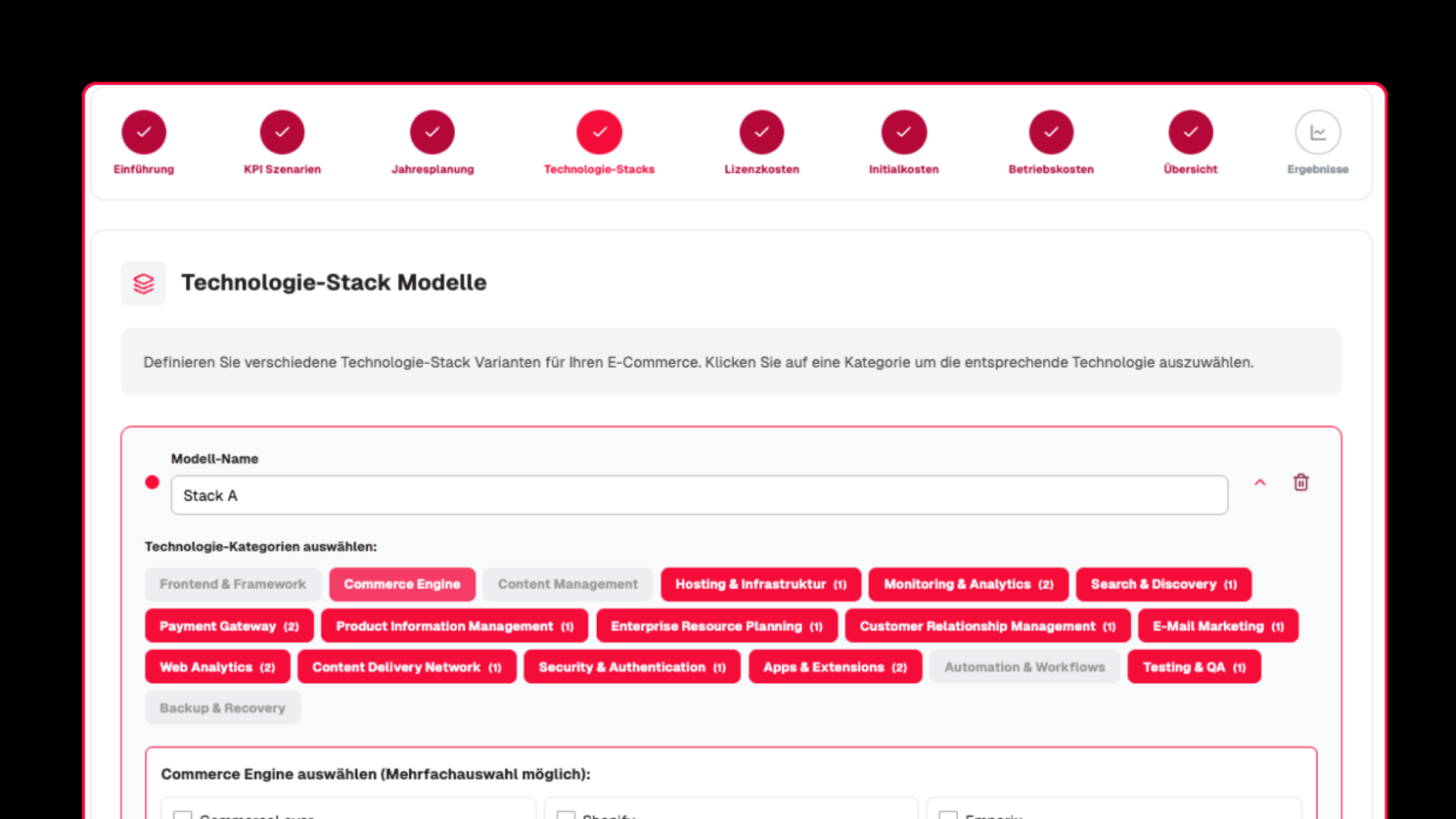
Price tag trap: How retailers ruin their calculations when relaunching store systems
ALSO INTERESTING
Merch as a service
Merch as a Service is a curated operating infrastructure: we take proven SaaS solutions and orchestrate them into a functioning ecosystem – coordinated with each other, ready for production from the outset.
The result: an operation that runs reliably, predictably and efficiently. No vendor lock-in, no proprietary dependencies – all building blocks are established market solutions that we configure, orchestrate and operate for you.

gamescom 2025: The Shopmacher improve digital orientation, creator access and community feeling
Find better, trade fairly, celebrate stress-free: the gaming event gamescom has further optimized its digital platform in 2025. The e-commerce agency Shopmacher is responsible for this for the fourth time in a row. With an interactive hall plan, an update to the digital adventure game epix and a completely revised signing area tool, Shopmacher has improved the community feeling and user convenience.

The initial situation: Why a foundation made of toothpicks brings down every project
Anyone building a house first checks the building ground. Anyone starting a digital project often ignores this step and is later surprised to find cracks in the façade. The problem: every unresolved assumption about the actual condition costs many times over in the later course of the project. If there is a lack of documentation and the knowledge only exists in the heads of individual employees, every innovation becomes a risky blind flight.